
|
Mortierella spp. by Dorota Porazinska Mortierella species are aseptate, filamentous soil fungi belonging to the order of Mortierellales of the Zygomycota phylum. Among the 70+ described species, most are commonly found in soil. As saprophytic organisms (those that live on dead or decomposing matter), they can be associated with a multitude of substrate sources including plant litter. A unique feature of Mortierella is that some species are known to be exceptionally well adapted to living under very cold conditions typical of arctic, Antarctic and high alpine snow-covered soils. As psychrophilic (cold-loving), they can grow at near- or even below-freezing temperatures and survive freeze-thaws cycles and desiccation. To tolerate cold, they employ physiological mechanisms that diminish the possibility of cellular water to freeze, crystalize, and rupture cell membranes. The most common mechanisms include production of trehalose and cryoprotectant sugars that stabilize membranes, glycerol and mannitol that maintain turgor pressure, unsaturated fatty acids that maintain fluidity of membrane structures, and antifreeze proteins that may slow the growth of ice crystals. 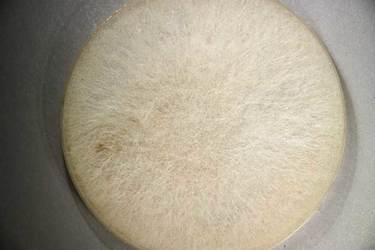 Fig. 1. A Mortierella fungus growing on a plate in the lab. At our field site at Niwot Ridge in the Colorado Rocky Mountains, Mortierella species can be easily observed as white mats, also known as “snow molds”, that quickly appear at the edges of receding snow banks in the spring time. Their incredible fast growth rates have been attributed to their ability to rapidly exploit a fresh flush of nutrients stored in soil and water from melting snow. However, as soon snow is gone, they disappear as fast as they appeared. In a recent survey of soil communities from a range of soil habitats spanning bare to increasingly vegetated, the abundance of Mortierella spp. declined where plant communities have become more established. Because increasing incidence of plants in this landscape reflects diminishing snow cover likely due to climate warming, the future of cold-loving Mortierella spp. lies in “hands” of surviving snow packs keeping high alpine ecosystems free of vegetation.
Literature Resources Schmidt SK, Wilson KL, Meyer AF, Gebauer MM, King AJ. 2008. Phylogeny of ecophysiology of opportunistic “snow molds” from a subalpine forest ecosystem. Microbial Ecology, 56: 681-687. Robinson CH. 2001. Cold adaptation in Arctic and Antarctic fungi. New Phytologist, 151: 341-353.
0 Comments
|
AuthorVarious lab members contribute to the MoM Blog Archives
October 2023
Categories |
 RSS Feed
