
|
Boletus edulis Cliff Bueno de Mesquita Hello! This month’s microbe is a tasty one – the King Bolete (or Porcini) mushroom (Boletus edulis). At our Colorado field site, we have been seeing these mushrooms pop up in the subalpine as we walk up to our plots! It is abundant in the Colorado subalpine forests because of its association with spruce trees. The fungus forms a symbiotic ectomycorrhizal association, meaning it envelops roots but does not penetrate them extensively like an arbuscular mycorrhizal fungus. B. edulis, like other ectomycorrhizae, helps trees acquire nutrients and can also increase the ability of seedlings to resist water stress. 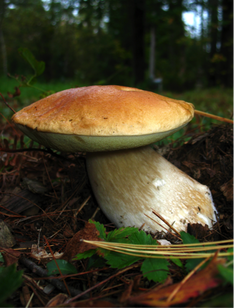 B. edulis is basidiomycete fungus (Phylum Basidiomycota) that is widely distributed across Europe, Asia, and North America, where it associates with a variety of tree species besides spruce. Fruiting bodies (mushrooms) of the fungus appear in the summer to fall, especially after rain and wet conditions. Drought, low humidity, and low night air temperatures and frost events inhibit the appearance of the fruit bodies. The cap of the mushroom ranges from 7 to 30 cm in diameter. The underside of the cap has a spongey, not gilly, texture. The mushrooms are edible and are widely renowned for their great taste.
References: Hall IR, Lyon AJ, Wang Y, Sinclair L (1998). "Ectomycorrhizal fungi with edible fruiting bodies 2. Boletus edulis". Economic Botany. 52 (1): 44–56. doi:10.1007/BF02861294. Hall IR, Stephenson SR, Buchanan PK, Yun W, Cole A (2003). Edible and Poisonous Mushrooms of the World. Portland, Oregon: Timber Press. pp. 224–25. ISBN 0-88192-586-1. Kasparavicius, J. (2001). "Influence of climatic conditions on the growth of fruit bodies of Boletus edulis". Botanica Lithuanica. 7 (1): 73–78. ISSN 1392-1665. Kozikowski GR. (1996). "Foray Report from Skye". Mycologist. 10 (4): 183–84. doi:10.1016/S0269-915X(96)80022-X. Quan L, Lei ZP (2000). "A study on effect of ectomycorrhizae on promoting Castanea mollissima resistance to drought and its mechanism". Forest Research (in Chinese). 13 (3): 249–56. ISSN 1001-1498.
0 Comments
|
AuthorVarious lab members contribute to the MoM Blog Archives
October 2023
Categories |
 RSS Feed
