
|
by Cliff Bueno de Mesquita Leohumicola is another genus of fungi that we found frequently in the roots of the alpine cushion plant Silene acaulis (see May post). Unlike Serendipita, which I wrote about last month, Leohumicola are members of the phylum Ascomycota. Not only was Leohumicola one of the more abundant fungi in the Silene plants, it also differed among our various experimental treatments. In addition to sequencing roots of adult Silene plants from Ireland and Colorado, we conducted a greenhouse experiment in which we grew Irish Silene plants in both Irish and Colorado soil, and Colorado Silene plants in both Irish and Colorado soil. Interestingly, Leohumicola was most abundant in Colorado adult Silene plants and Irish seedling Silene plants. 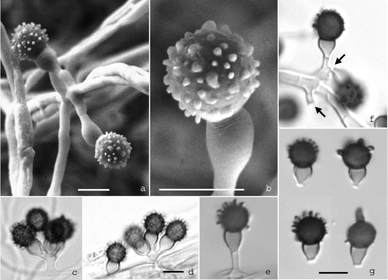 Figure 1. Scanning election microscopy graphs of Leohumicola verrucosa. From Hambleton et al. 2005. Leohumicola was described as a new genus in 2005, with 4 species (Hambleton et al. 2005). This group of fungi displays a remarkable range of temperature tolerances, as it has been found in high alpine environments as well as heat treated soils. One species, Leohumicola verrucosa (Figure 1) has been isolated from a pharmaceutical plant (Pleione yunnanensis) in China (Chen et al. 2009). Leohumicola have also been reported to associate with plants in the Ericaceae family, and to form ericoid mycorrhizal structures (Bizabani et al. 2016). As discussed in previous posts, mycorrhizae are fungi that associate with plants in a mutualistic relationship in which both parties benefit; the fungus receives carbon from the plant, and the plant receives nutrients from the fungus. Ericoid mycorrhizae are fungi that associate with plants in the Ericaceae family, and are characterized by forming dense coils in the plant cells for nutrient exchange (Figure 2). Researchers reported Leohumicola in commercial blueberry roots, and increased plant growth in plants with the fungus. Thus, it appears that Leohumicola could have beneficial impacts on plant growth, and potentially play a role in the growth of plants outside of the Ericaceae, like our Silene plants (family Caryophyllaceae). 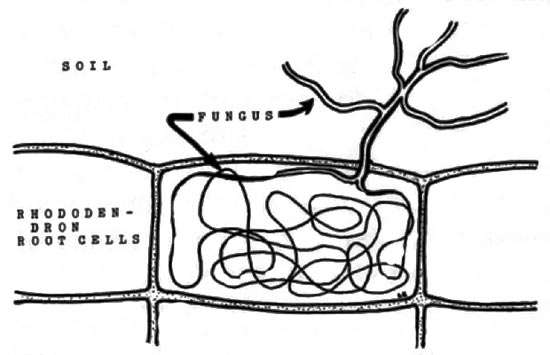 Figure 2. Drawing of an ericoid mycorrhizal fungus. By Dr. Larry Englander. https://scholar.lib.vt.edu/ejournals/JARS/v34n1/v34n1-englander.htm References:
Bizabani, C., Fontenla, S., and Dames, J.F. 2016. Ericoid fungal inoculation of blueberry under commercial production in South Africa. Scientia Horticulturae 209: 173-177. Chen, J., Meng, Z., Chen, X., Lu, Y., Zhang, F., Li, X, and Guo, S. 2009. Leohumicola, a genus new to China. Mycotaxon 108: 337-340. Hambleton, S., Nickerson, N.L., and Seifert, K.A. 2005. Leohumicola, a new genus of heat-resistant hyphomycetes. Studies in Mycology 53: 29-52.
0 Comments
|
AuthorVarious lab members contribute to the MoM Blog Archives
October 2023
Categories |
 RSS Feed
